

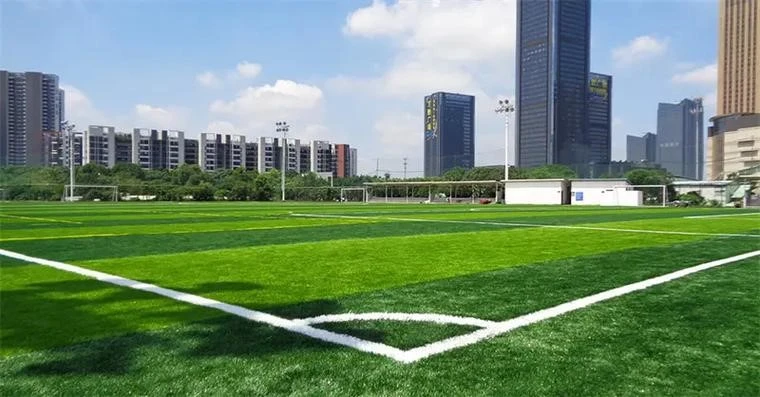
With the vigorous development of the global sports industry, especially the popularity of sports such as football, hockey, and rugby, the demand for the quality of sports venues is increasing. Chinese artificial grass enterprises seize this opportunity, promote product iteration through scientific research and innovation, actively deploy the global supply chain system, and gradually occupy an important position in the international market. According to data from the General Administration of Customs of the People's Republic of China, in the first and second quarters of 2024, my country's artificial grass exports increased by 15.64% and 5.08% year-on-year respectively, showing the strong competitiveness of Chinese companies in the international market.
Against the backdrop of economic slowdown, expanding the international market has become an important strategy for companies to open up the "second curve". Chinese artificial grass companies have gradually broken the monopoly of old European and American companies with the three magic weapons of "innovation + patent + supply chain". In the past, European and American companies monopolized the high-end sports grass market with the certification barriers and localized services of international authoritative sports organizations. However, in recent years, the Chinese artificial grass industry has gradually captured the international market through continuous technological innovation and patent layout. According to the Annual Development Report of Artificial Grass Industry (2023), the total output scale of the industry has continued to grow since 2019, with growth rates of 13.42%, 13.16%, 9.95% and 3.35% from 2020 to 2023, respectively. In addition, as of September 5, 2024, Chinese companies have obtained 322 FIFA Quality & Quality PRO field certifications worldwide, further proving the improvement of their product quality.


Faced with a complex domestic and international competitive environment, enterprises have become the key to success in cultivating "internal strength". Chinese artificial grass companies no longer rely on low-cost strategies, but increase product added value through material innovation, patent layout and supply chain optimization. AMI Consulting data shows that in 2021, my country's demand for artificial turf reached 82 million square meters, accounting for 23.41% of global demand, and production capacity accounted for about 60% of the world, of which about 61% of production was exported.
However, the uncertainty of the international economic and trade environment poses a considerable risk to enterprises. Since the outbreak of the Sino-US trade war in 2018, some countries have imposed higher tariffs on my country's artificial grass exports, which has put exports at a disadvantage. For this reason, Chinese artificial grass companies have turned to setting up overseas production bases to reduce costs, improve efficiency, and further consolidate their position in the international market.
Overall, Chinese artificial grass companies are shaping new international competitive advantages through innovation-driven and global layout, and are gradually becoming an important force in the global sporting goods market.


