

For importers, wholesalers, garden centers, and landscape contractors, choosing a suitable manufacturer involves more than comparing product prices. Tree dimensions, foliage materials, base construction, outdoor suitability, customization options, packaging, and bulk-order consistency all affect the final purchasing decision. The following list introduces five manufacturers and suppliers in China for buyers exploring artificial topiary tree sourcing. The list is not a ranking.

Top 5 Artificial Topiary Tree Manufacturers
|
Manufacturer |
Main Products |
|---|---|
|
Zhejiang Ruopei Arts & Crafts Co., Ltd. |
Artificial topiary trees, artificial hedges, artificial plants |
|
Heshan Senmao Craft Co., Ltd. |
Artificial topiary plants, potted trees, grass balls |
|
Sunwing Industries Ltd. |
Artificial topiary trees, boxwood balls, spiral trees |
|
Dongguan Guansee Artificial Landscape Co., Ltd. |
Artificial landscape trees, decorative plants, topiary products |
|
Guangzhou Dajia Landscape Ltd. |
Artificial plants, topiary ball trees, decorative greenery |
Zhejiang Ruopei Arts & Crafts Co., Ltd.
Zhejiang Ruopei Arts & Crafts Co., Ltd. is a Chinese manufacturer and supplier of artificial greenery and decorative plant products. Its product range includes artificial topiary trees, artificial hedges,and other decorative greenery for residential and commercial environments.
For wholesalers and project suppliers, Ruopei offers several product categories that can be considered together when developing an artificial greenery collection.
Key points for buyers:
- Product variety: Artificial topiary trees and other decorative greenery can support coordinated product sourcing for different interior and landscaping projects.
- Shape and size selection: Buyers can discuss tree height, topiary shape, foliage appearance, and pot styles according to their product requirements.
- Project applications: Artificial trees can be selected for entrances, reception areas, retail displays, hospitality spaces, and other decorative settings.
- Wholesale coordination: Product specifications, packaging requirements, and order quantities should be confirmed before production to help align bulk orders with the intended sales channel.
Ruopei is worth considering for businesses looking to source artificial topiary trees alongside related artificial greenery products from the same supplier.

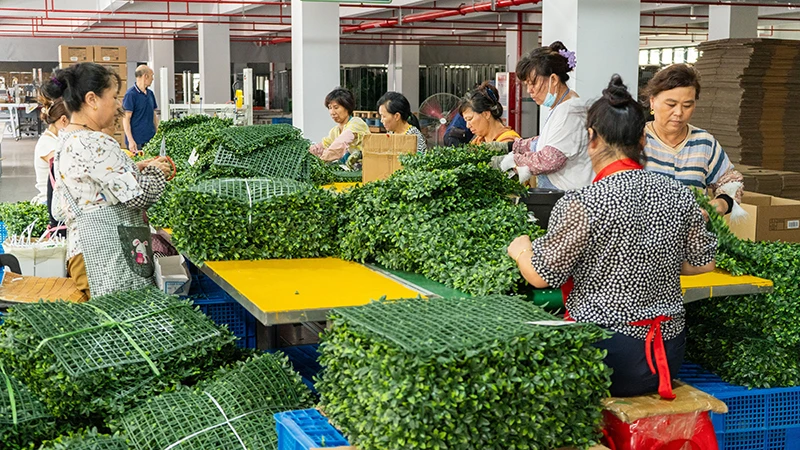

Heshan Senmao Craft Co., Ltd.
Heshan Senmao Craft Co., Ltd. is a manufacturer of artificial plants based in Guangdong, China. Its product range includes topiary plants, artificial trees, bonsai, grass balls, and other decorative plant products.
Sunwing Industries Ltd.
Sunwing Industries Ltd. supplies artificial topiary trees in styles including boxwood ball trees, spiral trees, and cedar cone topiary. Its product offering also includes customization options for foliage, branches, planters, and branding requirements.
Dongguan Guansee Artificial Landscape Co., Ltd.
Dongguan Guansee Artificial Landscape Co., Ltd. supplies artificial landscape products and decorative greenery. Buyers considering its products should confirm the available topiary styles, dimensions, materials, and customization scope for their specific projects.
Guangzhou Dajia Landscape Ltd.
Guangzhou Dajia Landscape Ltd. offers artificial plants and decorative greenery, including artificial topiary ball trees. It may be considered by buyers comparing decorative plant styles for retail, residential, and commercial applications.
What Materials Are Used in Artificial Topiary Trees?
Artificial topiary trees commonly use plastic foliage, a supporting frame or trunk, and a base or planter. The specific materials influence foliage appearance, product weight, flexibility, and suitability for different environments.
Buyers should request details about the foliage material, trunk structure, pot construction, and any UV-protection treatment. For outdoor projects, ask whether the product has been designed and tested for the expected sunlight and weather exposure rather than assuming that every artificial tree is suitable for outdoor use.
How Do Tree Height and Shape Affect Product Selection?
Tree dimensions should match the installation space and the intended visual effect. Compact ball-shaped trees may suit entrances and smaller display areas, while taller spiral trees can be used as decorative features beside doors, walkways, and building entrances.
Before placing a bulk order, confirm the overall height, maximum width, pot dimensions, and product appearance. Buyers should also clarify whether the stated height includes the planter, as inconsistent measurement methods can complicate product comparisons.
What Should Buyers Know About Outdoor Installation?
-
UV Resistance: Prolonged sunlight can cause artificial foliage to fade or become brittle. Buyers should confirm whether the leaves use UV-resistant materials or treatments suitable for the expected level of sun exposure.
- Weather and Moisture Protection: Rain, humidity, and temperature changes may affect foliage, trunk components, and planters. Confirm that the selected model is designed for the intended outdoor conditions and check whether the planter requires drainage.
- Wind Resistance and Base Stability: Tall trees and dense foliage can catch wind, increasing the risk of tipping. Check the product's weight, planter dimensions, and fixing options. Exposed locations may require a heavier base or additional anchoring.
- Installation Surface: Soil, concrete, paving, and decking may require different installation methods. Buyers should provide site photos or installation dimensions so the supplier can recommend a suitable base and fixing arrangement.
- Packaging and Maintenance: Foliage can become compressed during transportation, so confirm how branches and the trunk are protected in the packaging. After installation, periodic cleaning and occasional reshaping may be necessary to maintain the tree's appearance.
How Should Buyers Compare Artificial Topiary Tree Suppliers?
Price is only one part of the sourcing decision. A useful comparison should consider the complete product specification, customization requirements, shipping arrangement, and expected order volume.
Product consistency: Check whether the supplier can maintain the approved shape, color, dimensions, and planter style across repeat orders.
- Customization scope: Confirm which changes are available and whether they affect the minimum order quantity or lead time.
- Packaging method: Ask how foliage and tree structures will be protected during storage and international transportation.
- Order planning: Confirm sample availability, production lead time, order quantity, and the process for handling specification changes.
- Communication: Ensure that drawings, reference images, material details, and inspection requirements are documented clearly before production.
Comparing suppliers against the same product specification makes quotations easier to evaluate and reduces the risk of choosing a product that does not meet the intended application.
Why Choose Zhejiang Ruopei Arts & Crafts Co., Ltd.?
When comparing artificial topiary tree suppliers, buyers should also consider how well a manufacturer supports product planning, specification confirmation, and ongoing wholesale orders.
- Product Range Development: Ruopei's artificial greenery categories provide a starting point for businesses developing coordinated decorative plant collections for different customer segments.
- Product Specification Coordination: Buyers can clarify appearance requirements, product dimensions, and presentation details before confirming the final order specifications.
- Support for Different Sales Channels: Artificial greenery products can be selected for garden retailers, home décor distributors, hospitality projects, and commercial landscaping, depending on each model's suitability.
- Clearer Order Preparation: Confirming samples, product details, packaging instructions, and order requirements in advance helps both parties establish a shared reference for production and delivery.
FAQ
1. What are the most common artificial topiary tree styles?
Common styles include spiral trees, boxwood ball trees, cone-shaped trees, and multi-ball topiary trees.
2. Can artificial topiary trees be used outdoors?
Some models are designed for outdoor use, but buyers should confirm UV protection, weather suitability, and installation requirements for each product.
3. Can manufacturers customize artificial topiary trees?
Customization may include height, shape, foliage color, planter design, and packaging, depending on the manufacturer's capabilities.
4. What should buyers check before placing a bulk order?
Buyers should confirm dimensions, materials, sample approval, minimum order quantity, production lead time, packaging, and inspection requirements.
5. Should buyers request a sample before mass production?
Yes, a sample helps buyers evaluate the product's appearance, construction, dimensions, and suitability before committing to a larger order.


