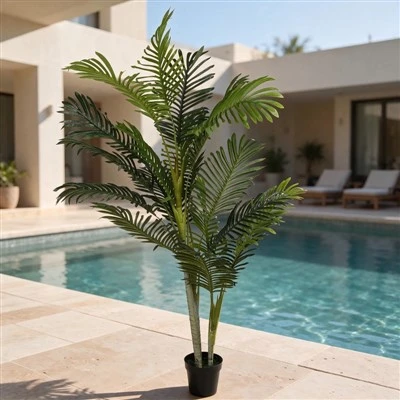
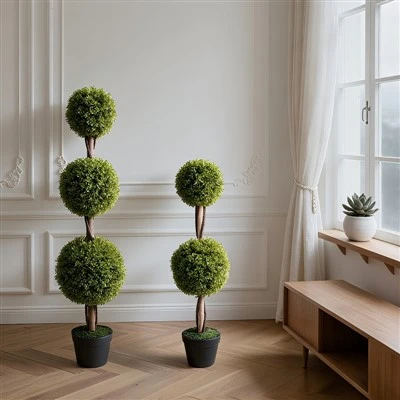
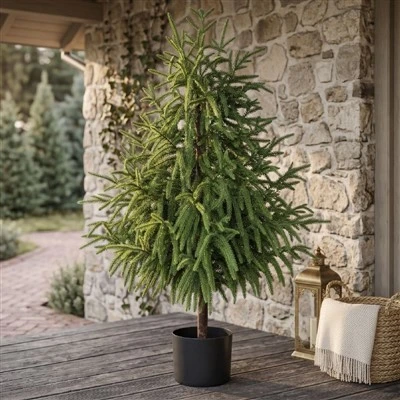
A fake ivy wall offers another way to achieve a green, foliage-covered appearance without relying on plant growth. By combining artificial leaves with supporting panels or fence structures, it can cover selected surfaces and create decorative green partitions in locations where maintaining live ivy would be difficult. For landscape contractors, wholesalers, and commercial project suppliers, understanding its structure, material performance, and installation requirements is essential when selecting products for different environments.
Why Are More Projects Considering Artificial Ivy Walls?
The decision to use artificial ivy is not simply about replacing natural plants. It is also related to how a space will be used, what maintenance resources are available, and how consistent the finished appearance needs to remain.
Natural ivy develops gradually and changes according to sunlight, moisture, temperature, and seasonal growth. It may need trimming to prevent excessive coverage around windows, entrances, or walkways. In commercial settings, these tasks can create additional maintenance work.
Artificial ivy panels provide a pre-arranged foliage surface that can be installed according to the dimensions of a wall or fence. Once secured, the decorative coverage does not depend on watering, root development, or growing conditions.
This makes artificial greenery worth considering for:
- Commercial entrances that need a consistent decorative background.
- Restaurant and hotel walls where regular plant maintenance is inconvenient.
- Garden fences requiring a foliage-covered appearance.
- Balconies and patios where planting space is limited.
- Exhibition and event installations that require a predetermined visual layout.
The choice still depends on the project. Natural ivy may be preferable when living vegetation and ecological functions are important, while artificial alternatives address decorative requirements with fewer plant-care responsibilities.
How Do Panel Structure and Leaf Arrangement Affect the Finished Wall?
The appearance of an artificial ivy wall depends on more than the number of leaves attached to a panel. Leaf distribution, supporting structures, and connections between individual units all influence the final installation.
Leaves arranged in overlapping layers can create a more dimensional appearance than foliage distributed across a single flat plane. Differences in leaf orientation also help reduce repetitive patterns when several panels are installed next to each other.
When evaluating samples, project teams should examine:
Leaf shape: Variations in size and outline help avoid an overly uniform surface.
Color distribution: Different green tones can create visual depth across the panel.
Foliage density: Leaf spacing determines how much of the backing structure remains visible.
Layer arrangement: Overlapping leaves help produce a fuller appearance from different viewing angles.
These details become particularly important on large walls. A panel that looks attractive individually may reveal repeated patterns when installed across a wider surface.
The backing structure supports the artificial foliage and provides a base for installation. Depending on the product design, panels may use a grid-like or mesh structure that can be attached to a suitable supporting surface.
For larger installations, the connection between adjacent panels deserves particular attention. Gaps, inconsistent alignment, and exposed backing sections can interrupt the overall green surface.
Before ordering in bulk, it is useful to assemble several samples together. This allows the installation team to inspect foliage continuity, connection points, and the appearance of panel boundaries rather than evaluating each unit separately.
What Material Properties Matter for Outdoor Artificial Ivy Walls?
Outdoor exposure creates different material requirements from indoor decorative applications. Artificial foliage may remain exposed to sunlight, rain, temperature fluctuations, and wind for extended periods. Therefore, product selection should consider the complete panel system rather than appearance alone.
Ultraviolet radiation can gradually affect plastic foliage. Depending on the material formulation and exposure conditions, leaves may lose color, become brittle, or show surface deterioration.
For outdoor projects, ask suppliers whether the foliage material contains UV stabilizers and whether supporting test documentation is available.
When reviewing test information, pay attention to:
- The testing method and exposure duration.
- Changes in color after UV exposure.
- Signs of cracking or material deterioration.
- Whether the test applies to the actual foliage material being supplied.
UV resistance should be evaluated through product-specific evidence. A general statement that a panel is suitable for outdoor use does not establish how it performs under every climate condition.
Rain and humidity can affect the condition of artificial greenery, particularly at connection points and supporting structures. Buyers should check whether the materials are suitable for the intended exposure and whether water accumulation may occur within the panel design.
Temperature changes are another consideration. Plastic components may expand, contract, or become less flexible under certain conditions. The mounting method should therefore accommodate the actual installation environment.
Artificial Ivy Walls vs. Other Green Wall Solutions
Not every project needs the same foliage appearance or installation method. Comparing different artificial greenery categories helps determine which product format is more appropriate.
|
Product Type |
Main Visual Characteristics |
Typical Applications |
|---|---|---|
|
Artificial Ivy Panels |
Climbing-vine appearance with distributed leaves |
Decorative walls, fences, and partitions |
|
Artificial Boxwood Panels |
Compact foliage with a more uniform hedge-like appearance |
Feature walls and privacy screens |
|
Artificial Grass Wall Panels |
Grass-like surface texture |
Decorative backgrounds and display areas |
|
Artificial Hedge Rolls |
Flexible roll format for covering extended surfaces |
Fence coverage and boundary decoration |
|
Natural Green Walls |
Living plants with changing growth patterns |
Landscapes and biophilic architectural projects |
A climbing-vine design creates a different visual effect from compact boxwood foliage. Similarly, grass-style panels provide a more uniform surface rather than the layered appearance associated with ivy.
For projects involving multiple decorative areas, combining different Artificial Hedges designs with other foliage formats can help distinguish entrances, partitions, and feature walls without using the same texture throughout the space.
Where Can Fake Ivy Walls Be Used?
The flexibility of modular foliage products allows them to serve different decorative functions, although material specifications and installation methods should be matched to each environment.
Artificial ivy can be installed on reception backgrounds, meeting-area partitions, and selected corridor walls. It provides a greenery-inspired surface without requiring natural light or irrigation infrastructure.
For office projects, the main considerations include panel dimensions, surface compatibility, and whether the installation needs to accommodate electrical outlets, signage, or access panels.
Hospitality and retail environments often use decorative foliage to create recognizable visual zones. Artificial ivy can be incorporated into restaurant feature walls, hotel common areas, display backgrounds, and branded photo spaces.
In these settings, consistent leaf arrangement and color matching across different panels are important because customers may view the wall from relatively short distances.
When installed on garden fencing, artificial ivy can create a continuous green appearance across an existing boundary. It may also be used as a decorative screening layer around patios and outdoor seating areas.
However, decorative coverage should not automatically be treated as a certified privacy or wind-screening solution. The actual degree of visual screening depends on foliage density and installation conditions.
Balconies often have limited room for planting containers and may receive insufficient sunlight for certain climbing plants. Artificial foliage panels provide a way to introduce green decoration without occupying additional floor space.
Depending on the building rules, installation may use an existing railing or a separate supporting frame.
How Can Artificial Greenery Manufacturers Support Different Project Requirements?
Product selection becomes more straightforward when manufacturers can provide clear information about panel dimensions, foliage designs, materials, and available product variations.
For example, a project requiring decorative wall coverage may need a different foliage format from one involving fence screening. Suppliers with a broader artificial greenery range can help customers compare suitable product types before finalizing specifications.
Ruopei's product range includes Artificial Ivy Panels and other artificial foliage products, alongside Artificial Green Wall solutions and related decorative greenery categories. Its portfolio also covers Artificial Grass Wall Panel products, providing additional options for projects that require different surface textures and foliage appearances.
For wholesale and project orders, useful points to confirm with the manufacturer include:
Available panel sizes and foliage designs.
Material details and outdoor-use documentation.
Sample availability before bulk production.
Color and design consistency across order batches.
Packaging methods for protecting foliage during transportation.
Product development and customization options where available.
Manufacturing communication should focus on confirmed product specifications rather than broad descriptions. Clear sample approval, order requirements, and inspection criteria make it easier to coordinate supply for commercial installations.
Why Choose Ruopei for Artificial Ivy Wall Products?
Choosing an artificial greenery supplier requires considering manufacturing capacity, product development, and supply capabilities. Ruopei combines in-house production resources with a broad artificial greenery product range to support different wholesale and project requirements.
Ruopei operates a 14,000 m² production facility with more than 100 employees and approximately 120 machines, including automatic and semi-automatic injection molding machines, robotic arms, and molding equipment. These resources support multiple stages of artificial greenery production.
Ruopei integrates product design, R&D, manufacturing, and sales. Its OEM and ODM services support the development of artificial greenery products based on different design and specification requirements.
Beyond Artificial Ivy Panels, Ruopei also supplies Artificial Hedges, Artificial Grass, Artificial Hanging Plants, and Artificial Trees. This product range allows wholesalers and landscaping suppliers to source different decorative greenery products through one manufacturing partner.
With products exported to more than 60 countries, Ruopei has experience supplying artificial greenery to international markets and coordinating product requirements for overseas customers.